If you’ve started looking into digital tipping for your hotel or venue, you’ve almost certainly hit the same fork in the road: NFC Tipping or QR code?
Both are contactless. Both are cashless. But they are not the same — and the difference matters more than most operators realise.
Here’s an honest breakdown of how the two technologies compare, and why the choice affects not just your guests but your staff’s take-home pay.
What Is QR Code Tipping?
A QR code tip works like this: a guest takes out their phone, opens the camera, points it at a printed or displayed code, waits for the link to load, navigates to the tip page, selects an amount, and completes payment.
It’s simple enough — and it works. QR code tipping has become widespread in restaurants and cafés because the codes are cheap to produce, easy to update, and require no hardware beyond a printed sticker or card.
The friction, however, is real. Each step between intention and action is an opportunity for a guest to abandon the process. A busy lobby, a dark restaurant, or a guest with older phone software can all interrupt the flow before the tip is ever sent.
What Is NFC Tipping?
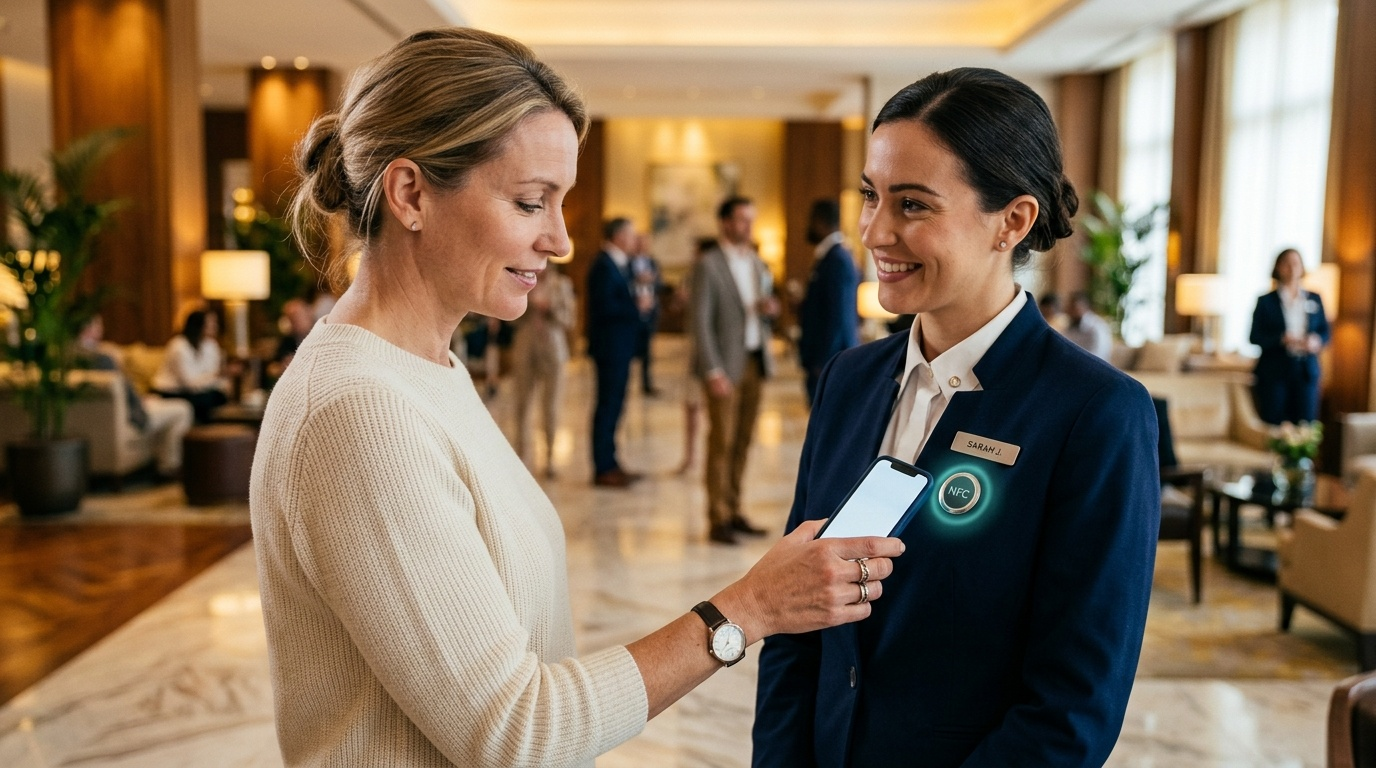
NFC (Near Field Communication) tipping works differently. A guest holds their phone near an NFC-enabled badge, keychain, wristband, or tag worn by a service worker. Their phone instantly opens the tip page — no camera, no scanning, no waiting.
The entire interaction takes roughly three seconds.
NFC is the same technology behind Apple Pay and Google Pay contactless payments. Most smartphones manufactured after 2018 support it natively. No app download is required.
Head-to-Head: The Key Differences
Speed and friction
NFC wins decisively. A tap is faster than a scan. The fewer steps between a guest’s impulse to tip and the completed transaction, the higher the conversion rate. Research from Canary Technologies found that staff see up to five times more tips when digital options are available — and that gap widens when the experience is effortless.
Hardware requirements
QR codes have the edge here. A printed sticker costs almost nothing. NFC tags require a small hardware investment — badges, keychains, or wristbands embedded with a chip. That said, NFC hardware is durable, reusable, and travels with the worker.
Portability
This is where NFC fundamentally changes the equation. A QR code is tied to a location — a table, a room, a desk. An NFC tag is worn by the worker. A housekeeper, valet, or bellhop who moves throughout a property — or changes employers — carries their tip identity with them. A QR code can’t do that.
Security
NFC has a meaningful security advantage. NFC technology is emerging as a game-changer in digital tipping, removing friction while maintaining the security standards guests expect. GratifID uses NTAG 424 DNA chips — the same cryptographic standard used in banking — which generate a unique, tamper-proof code on every single tap. QR codes, by contrast, can be photographed, copied, and redirected.
Guest experience
Both methods work without an app. But NFC is the more natural motion — it mirrors the tap-to-pay gesture guests already use at every checkout counter. For international guests unfamiliar with QR tipping conventions, NFC is more intuitive.
When QR Code Tipping Makes Sense
QR codes are a perfectly reasonable starting point, particularly for:
- Restaurants with fixed table settings where a code on the table or receipt works naturally
- Venues with very limited budgets for hardware
- Operations where staff don’t move around much
They’re also a good complement to NFC — some venues use both, giving guests multiple ways to tip depending on the context.
When NFC Tipping Is the Clear Choice
NFC tipping is the better fit when:
- Workers are mobile — housekeepers, valets, bellhops, bartenders, and shuttle drivers are rarely standing next to a fixed QR code
- Security matters — high-end hotels can’t risk guests being redirected to fraudulent tip pages through copied QR codes
- Staff retention is a priority — workers who earn more tips stay longer. NFC’s lower friction directly translates to higher tip frequency
- You want a portable identity — NFC tags owned by the worker go with them when they change shifts, venues, or careers
The Bottom Line
QR codes opened the door to digital tipping. NFC walks through it.
For hotels and hospitality venues serious about supporting their service teams in a cashless world, NFC tipping offers a faster guest experience, stronger security, and a worker-owned identity that no QR code can match.
At GratifID, every Tipmo tag uses NFC technology paired with NTAG 424 DNA security — because your staff deserve a tip solution built around them, not around a table.